So I know I promised at Thanksgiving an update on the state of things. Well I lied/got busy. Sorry; these things happen. The past few months have been a whirlwind. So here’s a brief personal update before I talk about software.
In May 2009 the Mac port of Chromium (the open source project that Google uses for their Chrome browser) was starting to gear up. I’d been interested in working on a Mac browser project for a while; but Firefox’s code seemed beastly and I never have been a fan of XUL. Safari is great, but it isn’t open source. Enter Chromium: an open-source, truly native, WebKit-based browser. Consider it love at first sight. Fast forward 12 patches and four months later to August when I am nominated and made a committer. My work has all involved bridging the cross-platform C++ model (as in MVC) to Objective-C/Cocoa land. I wrote the Mac the page info window, history menu, cookie manager, font and language settings, download settings, and added favicons throughout various parts of the UI. Now, present day. Last week Google offered me an internship position in Manhattan. I’m thrilled at the opportunity and am excited to start work there in May with such smart, interesting, and talented people. I expect to learn a lot!
So now let’s talk software.
Bugdar
Last time I wrote about the future of Bugdar 2, I posted a link to a list of phases development that would occur. The original plan was to create 1.3 as a stepping stone to 2.0. That line of development has since been abandoned. Instead, I decided to greenfield the project. There were many reasons for doing this; but here are the two big ones:
-
I have a better, more focused vision of what I want Bugdar 2 to be. When writing Bugdar 1, I didn’t have a clear goal of what I wanted — there was no philosophy to the design, I was merely thinking “copy Bugzilla, but do it better”. Overall, I think I was successful with this. But this is not Bugdar 2, at all. Bugdar 2 will be a refined, incredibly flexible system that I am excited to share with you. But because the two projects will be so different, trying to create a large, temporary scaffolding system (version 1.3) was extremely time consuming and kludgey.
-
ISSO. Originally dubbed the “Iris Studios Shared Objects” framework. This thing is ancient. The first version dates back to when I was a rather n00b PHPer. The first commit was from 12 January 2005! Since that time I’ve had a lot more development experience and completed a Minor in Computer Science. A better, more-efficient architecture could be devised.
I wrote an entirely new PHP framework (that will require PHP 5.3+) that is a bare-minimum, no-frills framework. I call this Phalanx and the code is currently available on Github; it is licensed under the GPL version 3. Phalanx is event-driven. Rather than writing another MVC framework, I decided to look at the problem of web frameworks through the lens of functional programming. The problem with MVC on the web is the lack of state; HTTP is not persistent. Functional programming focuses more on inputs and outputs (and the transformations between them), which is how Phalanx works. Each Event class defines a set of inputs that it accepts and the outputs it will return. This also makes unit testing much more clear-cut. I won’t get into further details here, though. That’s for another post.
So before I could start moving again on Bugdar, I had to write this new framework. That took a matter of months (July – January). But I’m now back on Bugdar. Phalanx makes development really fast, and in the past two days I’ve implemented the basic user system, a preliminary Auth2 API, and initial submission and listing of bug reports. I’ve posted a new roadmap for Bugdar 2.
MacGDBp
I’ve been refactoring and cleaning up MacGDBp’s code over the past few months. It’s also been accumulating various fixes for non-critical bugs. I’d also like to re-tackle the socket/network layer for 1.4, as I tried and failed to improve this in 1.3. You can probably expect this update before Spring.
Site Redesign
I’m also working on redesign the Blue Static site. It really hasn’t changed since 2006 (insert the ‘learned a lot’ bit here) and it’s time. I’m not very far on this, yet.
Wow that’s a lot. More in the next few days. UI mocks to come.
Posted on November 27, 2009 at 03:47 UTC,
filed under the category
Bugdar.
Happy Thanksgiving to all you US citizens!
Today I’m releasing a security update to Bugdar, version 1.2.4. This version addresses a possible SQL injection vector in search.php. The details of the report can be found here. Thanks to Adam DiCarlo for disclosing the issue.
Please update to 1.2.4 as soon as you can. The release links can found on the normal Bugdar webpage. Alternatively, here are the direct ZIP and Tar links.
I apologize for the lack of posts, but I’d rather be coding rather than talking about coding ;). I’ll post an update on the state of Bugdar 2.0 in a few days.
I’m pleased to announce MacGDBp 1.3. This release features a new tool that allows you inspect values in the variables list via a HUD (screenshot below). This inspector will allow you to see long strings and to select/copy text values. To access this feature, go to Window → Inspector (Shift+Cmd+I). The currently-selected variable (which now, in 1.3, remembers itself across debugger stepping) will have its full value displayed in the HUD window.
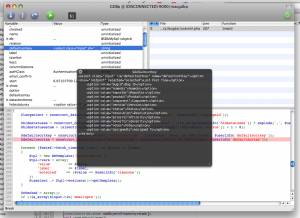
Under the hood, there are two significant changes. The first is a rewrite of the receiving side of the socket layer (it now precisely uses the message length when buffering memory), which should eliminate the “buffer is incomplete” errors that occasionally popped up. The second is that the PHP stack will no longer be managed internally. After every debugger step, the entire stack will be now re-created because Xdebug proved to be unpredictable for keeping in sync with an internal state. Debugger actions may now seem a little less snappy, but I think accuracy is more important than speed here. In 1.4 I’m going to use a caching mechanism that will speed up performance by reducing network access.
This release also features a bunch of bug fixes, a couple of which would cause the debugger display to not work under certain circumstances. As always, the change log and commit log have all the details on the release.
I cannot commit to a web browser. I like Firefox because I think it provides options (via extensions) and the awesome bar is, in fact, awesome. Safari however provides better platform aesthetic and WebKit is a faster rendering engine.
But besides that, I noticed recently that Firefox feels a little “cramped” after using Safari 4 beta. And this is the reason why:
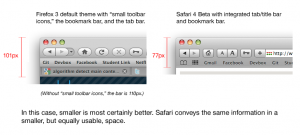
I’m amazed at what 24 pixels can do.
I’ve posted today a git repository called Toolchain. This is a collection of scripts that I use that others may find helpful. You can find the repository here. In this post, I’m going to talk about one of the items in Toolchain called Gitcrement.
Gitcrement is a set of two scripts that solves the problem of creating build numbers when using git for source control. Unlike Subversion, where the repository revision is the perfect choice for a build number, git has no such luxury because it uses SHA1 hashes for identifiers.
This is where Gitcrement comes in. Gitcrement is a simple interface to a database that contains a sequential ID number (the build number), a username, the current date/time, and a git SHA1 hash.
The gitcrement.py has four commands: init, next, list, and current.
To create a new Gitcrement database, go into any git repository root and type “gitcrement init“, which will create a new database file called .gitcrement.
When you want to create a new build number, simply type “gitcrement next” to record the current user (`whoami`), date and time, and whatever SHA1 hash `git info .` would reveal.
To see the current build number type “gitcrement current” and to get a list of all the build numbers type “gitcrement list“.
That’s all there is to it. To make this system useful, however, it needs a script that can be run in Xcode to automatically call “next” and save the value as CFBundleVersion in Info.plist. So, there’s another Python script called xcbuild.py, which you can use as a Custom Shell Script Build Phase. This will advance the Gitcrement number every time you build the “Release” target in Xcode.
Gitcrement requires Python 3.0, which is not installed by default in Leopard. You can find it here or through MacPorts or fink.
Also, you may need to edit the installation paths in the tops of both files to point to where your copy of “git” is (in gitcrement.py) and where you install the “gitcrement” script (in xcbuild.py).
You can download Gitcrement here:
Link in Gitweb
Source TGZ
« Older Entries
Newer Entries »